SLIDE TO VIEW ALL 11 PAGES: Mutterkorn, or: Beyond Donald. A slide-based essay on comic essays as epistemic tools developed through artistic research practice.
IN PLAIN TEXT:
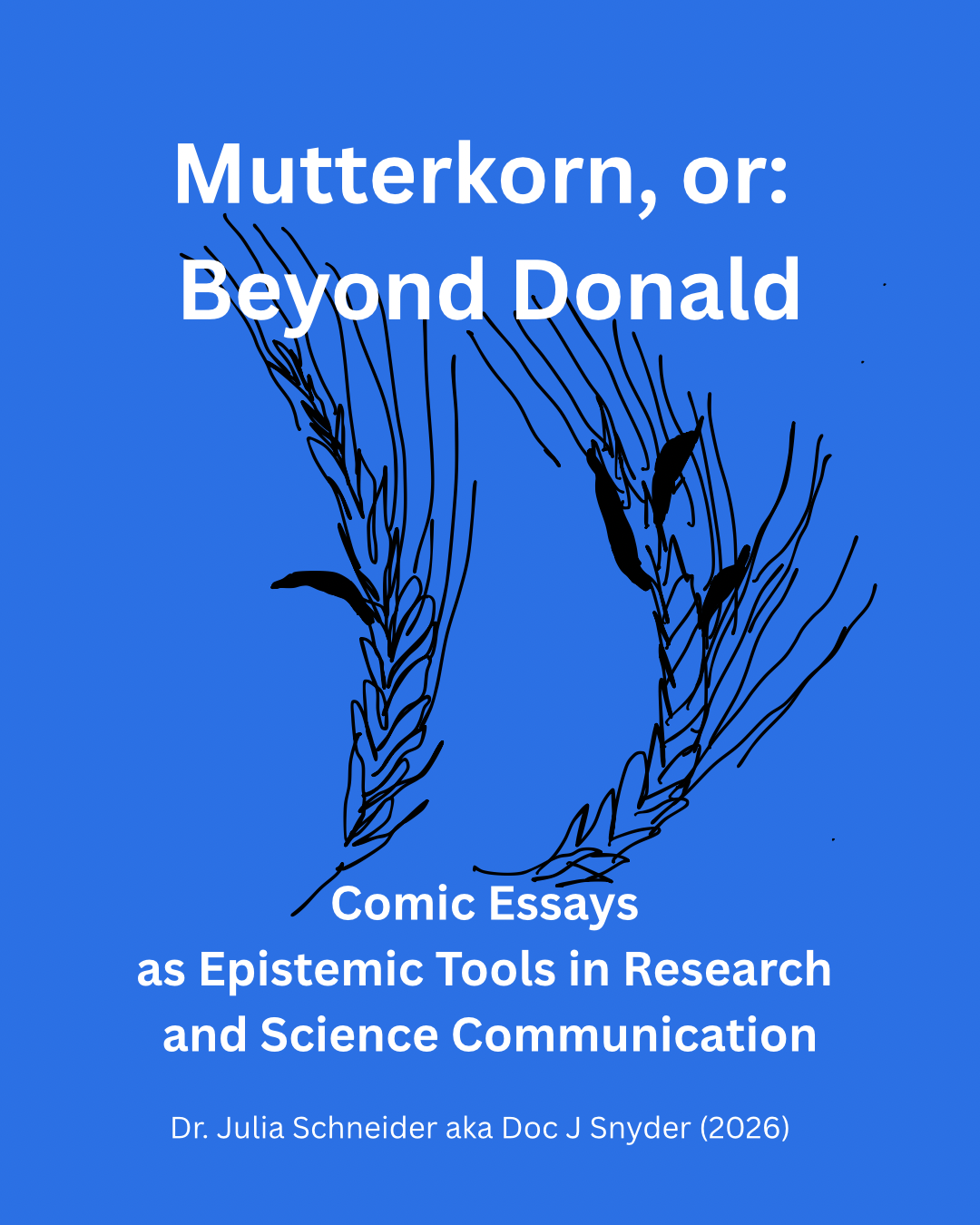
Mutterkorn, or: Beyond Donald. Comic Essays as Epistemic Tools in Research and Science Communication
Dr. Julia Schneider aka Doc J Snyder (2026)
“In my talks, artistic research projects, comics, and science communication workshops, the baseline has shifted. Nobody is asking anymore why we should open up academic silos. In times of today’s polycrisis (demographics, economy, climate, geopolitics, AI… you name it), that question is mostly settled (and yes, that actually makes me happy).
Most people agree we need every single talent on board to solve our real problems… and that class and status questions (like ‘but we need to impress with our academic jargon to show we are intelligent and important’) often stand in the way of this goal.
The question has therefore shifted to: How? How do we practically bridge the massive gap between heavy academic research and public action without losing intellectual rigor along the way? Without, if you will forgive the reference, sounding and acting like Donald T.?”
Slide 2
“And sure, as kids, many of us enjoyed the simplistic worldview of Donald D. and his friends.
This also leads to the question I often encounter regarding the target audience for my comic essays on complex topics such as AI, sustainability, money, copyright or the labor market: ‘Probably children, right? Do you think my nine-year-old would enjoy it?’
To make a long story short: usually not.
Indeed, they are also not written in “simple language”, but in a very condensed, highly associative style, which unfortunately makes them too complex for some older people as well.
On the bright side, they are always a little treat for the nerds and professionals (did you detect Shannon’s robotic mouse in “We need to talk, AI?”).”
Slide 3
“Okay, you might say.
So what is the point then of comic essays “as epistemic tools” (no simple language indeed, thank you very much), for thinking and for communicating complexity?
They are neither a 300-page book for the ‘broad audience’ written by an ‘AI expert’ that illustrates bulky text in the margins with a badly drawn robot while just parroting the academic script…
…nor are they for kids?
But they are short, without footnotes, often colorful, and…
…and yes, I saw cats in it too!!”
Slide 4
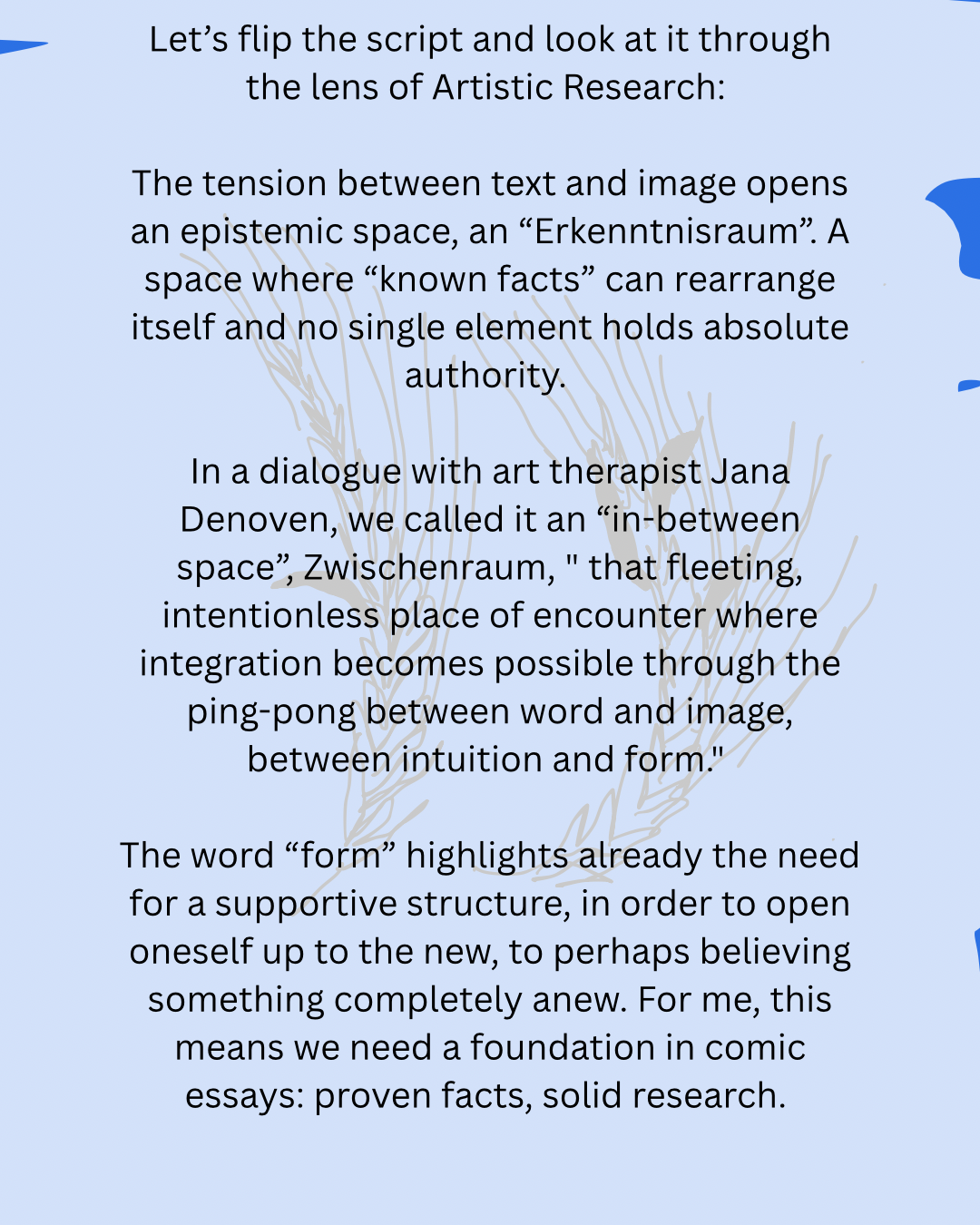
“Let’s flip the script and look at it through the lens of Artistic Research:
The tension between text and image opens an epistemic space, an “Erkenntnisraum”. A space where “known facts” can rearrange themselves and no single element holds absolute authority.
In a dialogue with art therapist Jana Denoven, we called it an “in-between space”, a Zwischenraum: ‘that fleeting, intentionless place of encounter where integration becomes possible through the ping-pong between word and image, between intuition and form.’
The word “form” already highlights the need for a supportive structure, in order to open oneself up to the new, to perhaps believe something completely anew. For me, this means we need a foundation in comic essays: proven facts, solid research.”
Slide 5
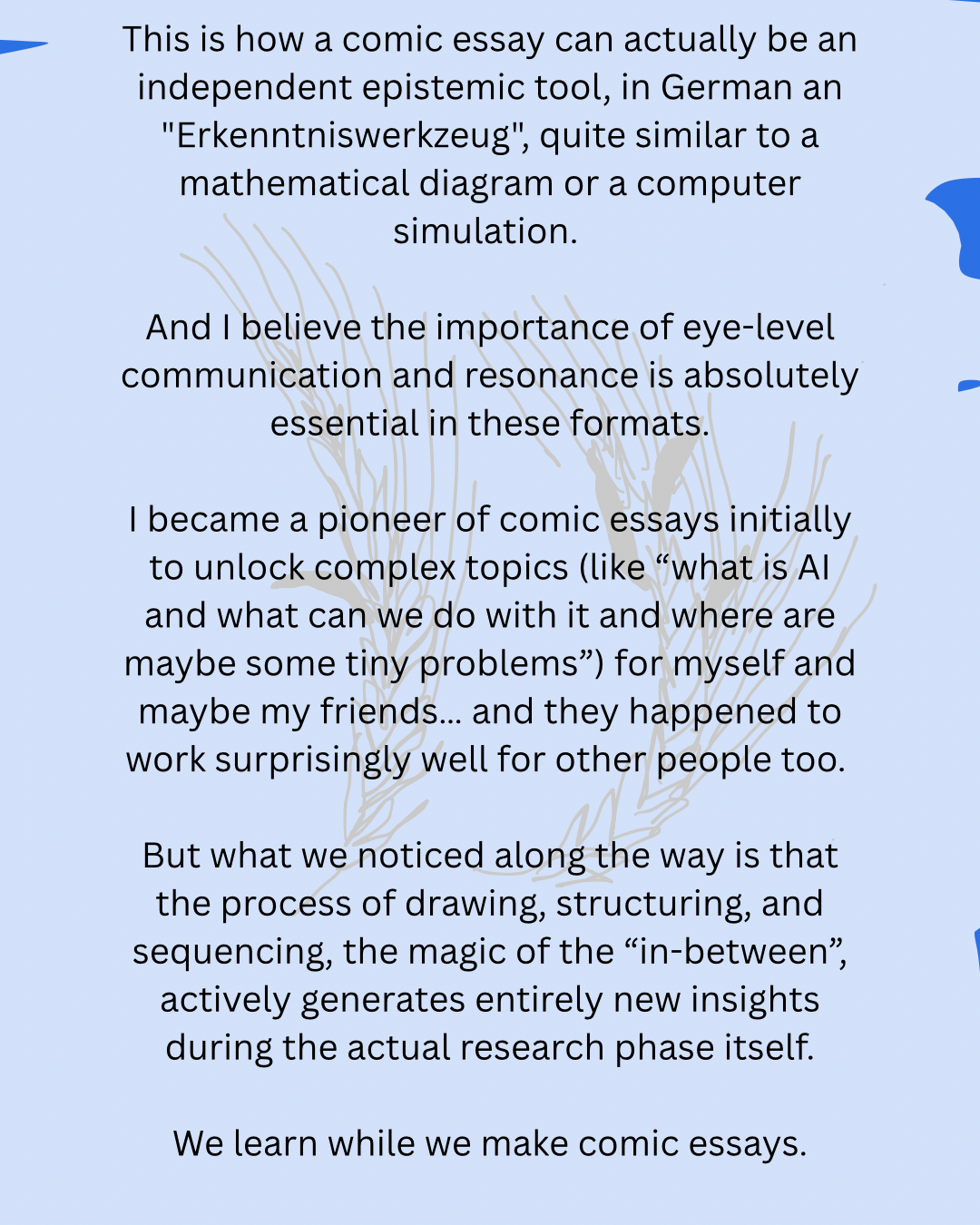
“This is how a comic essay can actually be an independent epistemic tool, in German an ‘Erkenntniswerkzeug’, quite similar to a mathematical diagram or a computer simulation.
And I believe that eye-level communication and resonance are absolutely essential in these formats.
I became a pioneer of comic essays initially to unlock complex topics (like “what is AI and what can we do with it and where are maybe some tiny problems”) for myself and maybe my friends… and they happened to work surprisingly well for other people too.
But what we noticed along the way is that the process of drawing, structuring, and sequencing — the magic of the “in-between” — actively generates entirely new insights during the actual research phase itself.
We learn while we make comic essays.”
Slide 6
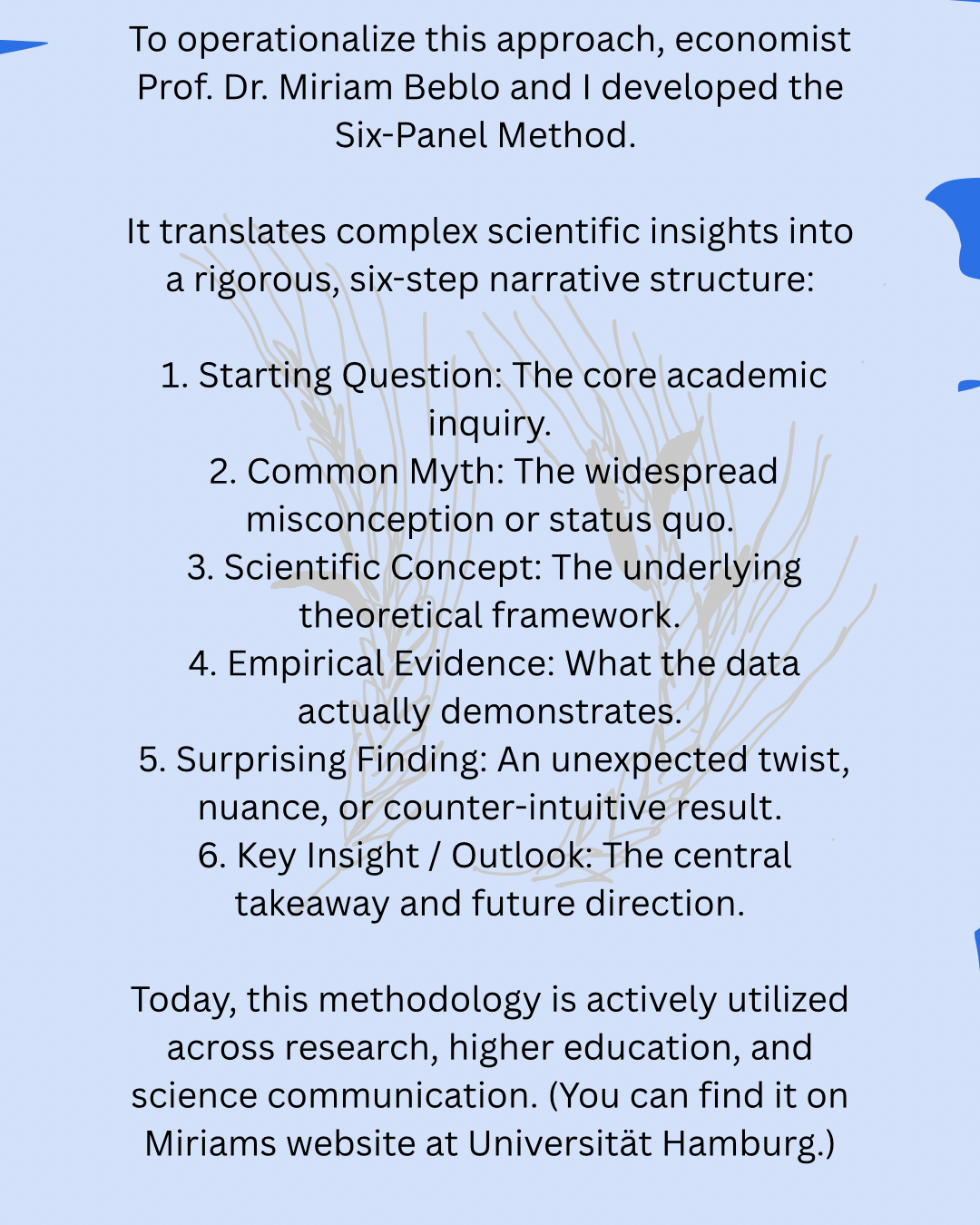
“To operationalize this approach, economist Prof. Dr. Miriam Beblo and I developed the Six-Panel Method.
It translates complex scientific insights into a rigorous six-step narrative structure:
- Starting Question: The core academic inquiry.
- Common Myth: The widespread misconception or status quo.
- Scientific Concept: The underlying theoretical framework.
- Empirical Evidence: What the data actually demonstrates.
- Surprising Finding: An unexpected twist, nuance, or counter-intuitive result.
- Key Insight / Outlook: The central takeaway and future direction.
Today, this methodology is actively used across research, higher education, and science communication. (You can find it on Miriam’s website at Universität Hamburg.)”
Slide 7
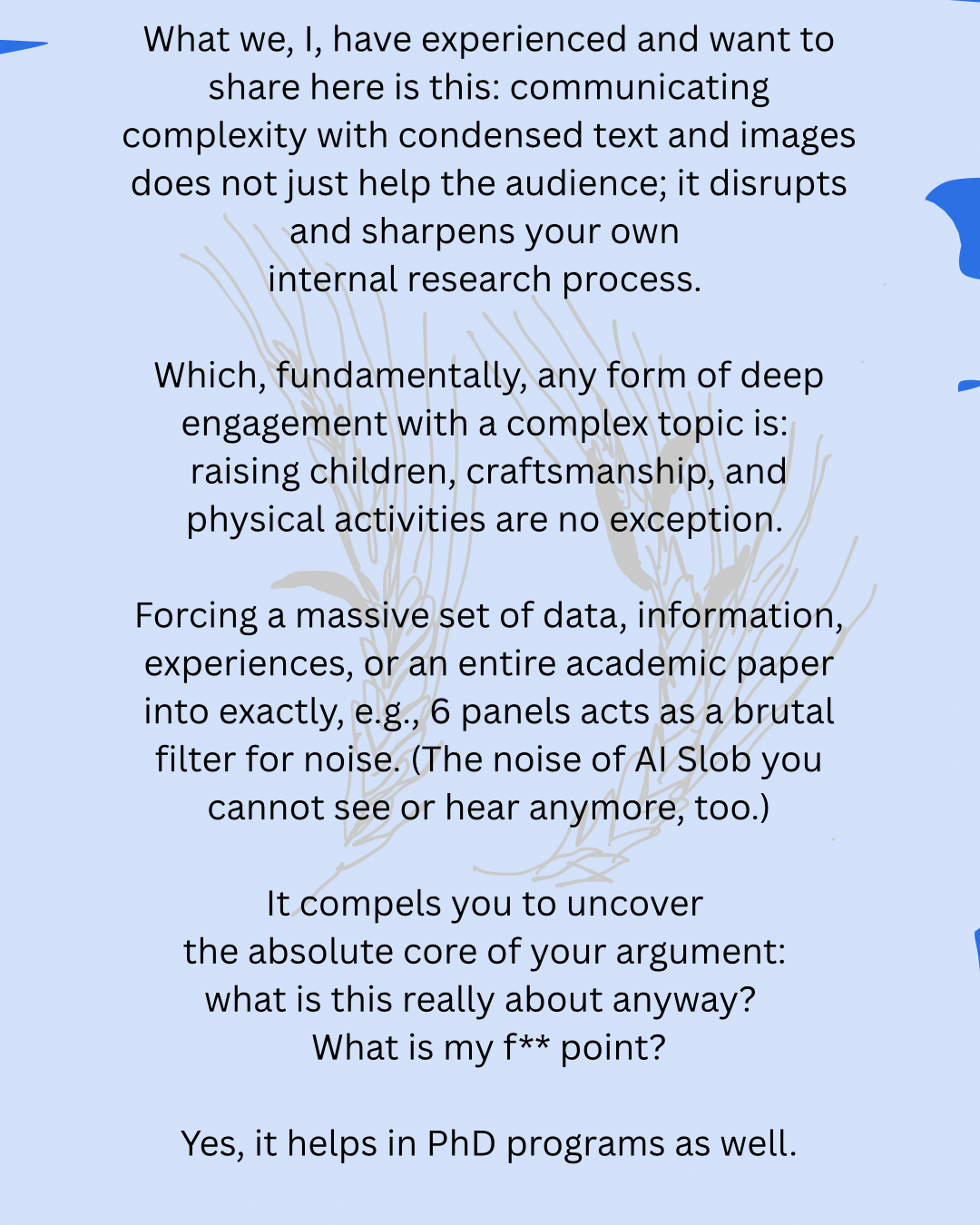
“What we, I, have experienced and want to share here is this: communicating complexity with condensed text and images does not just help the audience; it disrupts and sharpens your own internal research process.
Which, fundamentally, applies to any form of deep engagement with a complex topic: raising children, craftsmanship, and physical activities are no exception.
Forcing a massive set of data, information, experiences, or an entire academic paper into exactly, e.g., 6 panels acts as a brutal filter for noise. (The noise of AI slop you cannot see or hear anymore, too.)
It compels you to uncover the absolute core of your argument: what is this really about anyway? What is my f** point?
Yes, it helps in PhD programs as well.”
Slide 8
“Before and since, I have spent years pioneering the comic essay as a serious intellectual genre in its own right, using it on complex socio-economic systems…
…and collaborating with a lot of talented, wonderful people. Out came comic essays like “Money Matters”, “We Need to Talk, AI”, “Schokoroboter and Deepfakes”, “A Pigeon’s Tale”, and a nonbinary sea cucumber searching for seagrass, a “Non-Fungible Comic”,…
…and of course our latest project, “Proof of Work”, which translates top-tier economic research into 17 concrete, empirically tested tools on how we can truly build on every single talent.
(This is something we absolutely must do, our own biases aside, given the aforementioned polycrises, remember?)”
Slide 9
“Take as a recent example my “AI Job Shift Map” model. I developed it as two sequential comic essays, ‘Mapping the Shift’ and ‘Shifting the Map,’ as part of my ongoing artistic research process exploring how generative AI is transforming our work (a natural fit for me as labor economist and former AI expert, and incredibly exciting).
To explain: the Job Shift Map is a heuristic that breaks down job shifts caused by AI along two axes: pajamas/screen-intensity and predictability.
Later, we published the model alongside a more detailed text at 1E9, and Klaas Bollhöfer, co-founder of AI company Birds on Mars, programmed the interactive Job Shift Map, where you can see your substitutability… check it out if you like.”
Slide 10
“Using this method, making a comic essay, is the exact opposite of ‘AI workslop,’ a framework introduced by BetterUp and the Stanford Social Media Lab, and introduced to me by Marcus Voß <3.
Workslop is the unnecessarily long-winded email, or the paper that looks incredibly elegant and smart at first glance but is intellectually empty or full of errors.
Like Mutterkorn: a dark purple fungus resembling grain, but poisoning people’s main food supply… and therefore many people in the Middle Ages.
If distilled through the right structural constraint, however, it becomes the very thing that flips our perception entirely. Mutterkorn is the direct chemical ancestor of LSD.”